SBC LTER Research
SBC LTER was established in April 2000 with the goal of advancing a predictive understanding of how oceanic and terrestrial processes alter material flows to influence the ecology of coastal ecosystems. Diverse and productive marine forests of the giant kelp, Macrocystis pyrifera, serve as the focal ecosystem for our research.
The overarching themes of the SBC LTER’s four 6-year funding cycles:
2000-2006 (SBC I)
Identify and quantify inputs to giant kelp forest communities from the ocean and land, and documenting patterns and sources of spatial and temporal variation in key elements of kelp forest structure and function.
2006-2012 (SBC II)
Determine how environmental drivers acting over different spatial and temporal scales interact to influence the community structure and ecological functions of giant kelp forests.
2012-2018 (SBC III)
Understand how the structure and function of kelp forests and their material exchange with adjacent terrestrial and marine ecosystems are altered by disturbance and climate.
2018-2024 (SBC IV)
Understand how natural and human drivers influence giant kelp dynamics to alter the long-term structure and function of kelp forest ecosystems
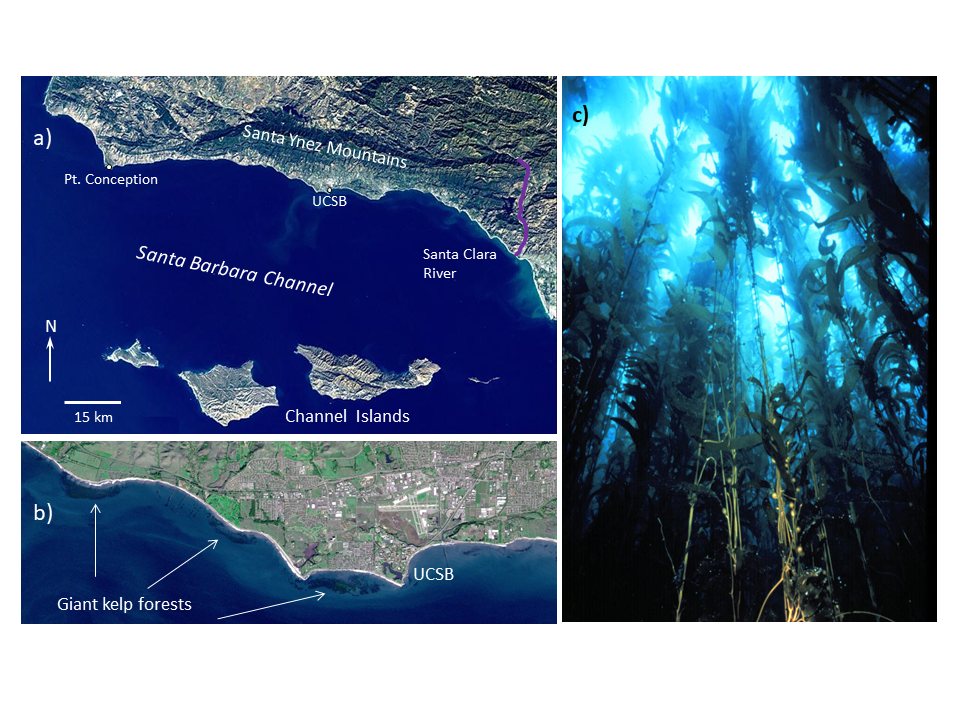
(a) Map of the SBC LTER study domain, (b) Satellite image showing the close proximity of giant kelp forests to the land-sea interface, (c) Submarine view of a giant kelp forest.